DIY Vacuum Tube Amplifiers
Website of EJ Jurich
Peanut Half-Watt
6SN7 Headphone Amplifier
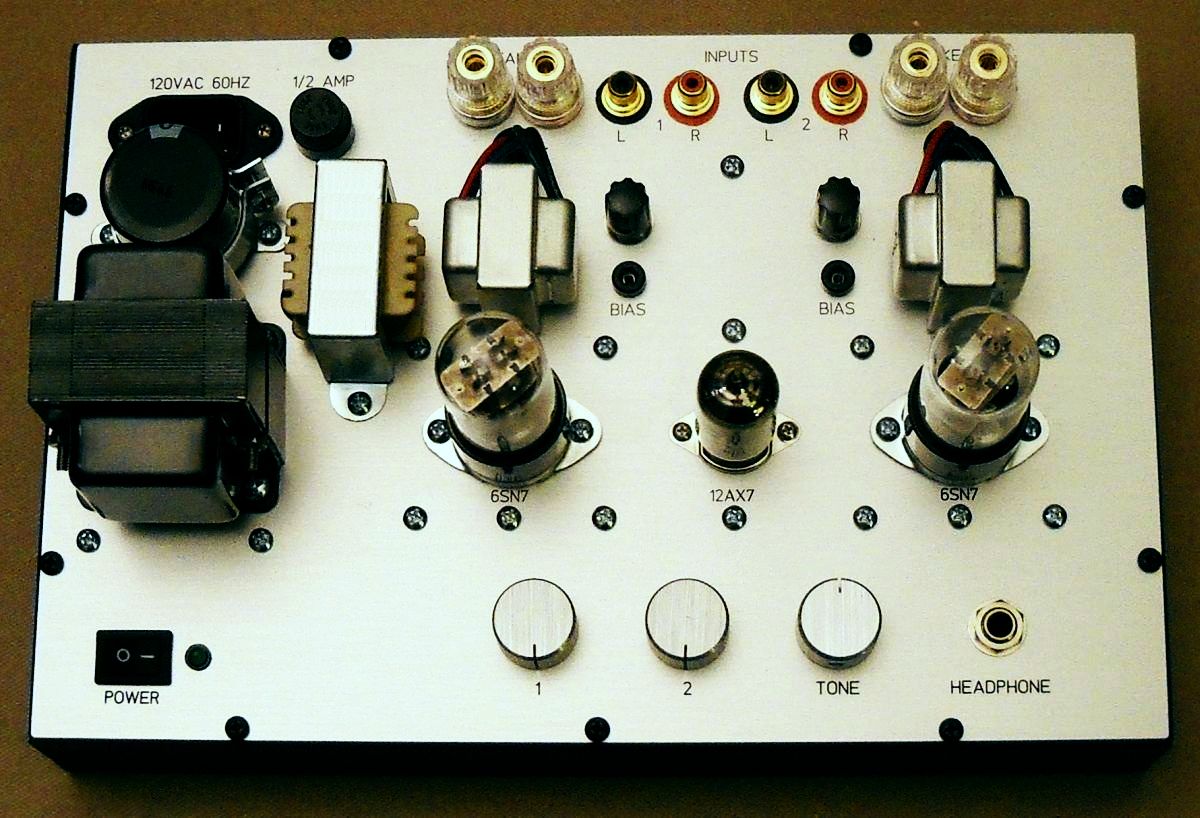
This was an experimental project in 2012 using a 6SN7 as a single-ended output tube. Measured power output at 1 KHz is a half-watt sufficient to drive headphones and speakers in a small room to a moderate listening level. There are two inputs, each with their own level control in a mixer configuration. With the tone control set in its middle rotation frequency response measured 40 Hz to 18 KHz -3 db points. The tone control only adjusts the high end; full rotation right is high-end boost and full rotation left is high-end cut. Input sensitivity is 0.5 volts RMS in for half-watt out. The input has a low-cut filter rolling off frequencies below 40 hZ to help reduce bass distortion.
Power consumption for a tube amp is low, measured at 25 watts. With low power consumption, the amplifier puts out moderate heat and can be on for several hours a day without running up a large electric bill. Although a half-watt is not a lot of power, the amplifier will drive more efficient speakers loud enough for casual listening. The amplifier was used by this author for several months and found the sound quite pleasing. The amplifier was given away, and the new owner also found it enjoyable.
Compared to most vacuum tube amplifiers, this project is not very expensive to build. The most expensive item is the custom-milled chassis plate used here: a standard chassis would be considerably less expensive.
Experimental 6SN7 Amplifier
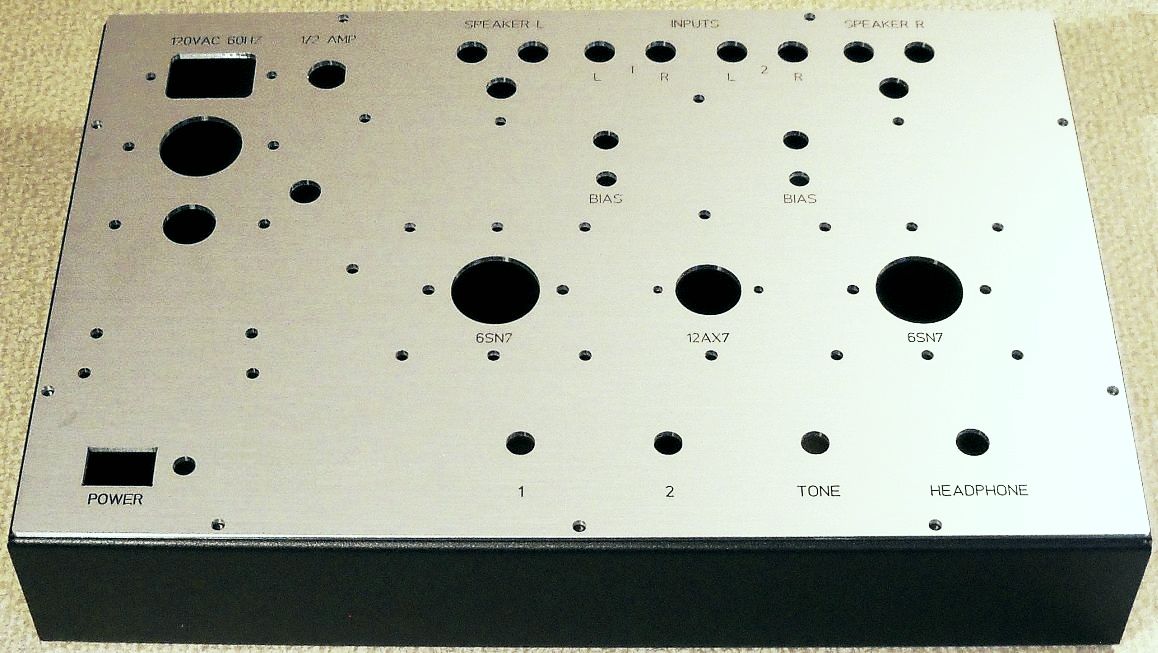
The chassis is a flat aluminum plate 3mm thick. All holes and lettering were milled to give the amplifier a professional look. The base is a black steel chassis upside down. The chassis flange holes were threaded to secure the chassis plate on top. Rubber feet are attached to the base bottom with screws in threaded holes.
Chassis plate sitting on top of chassis base
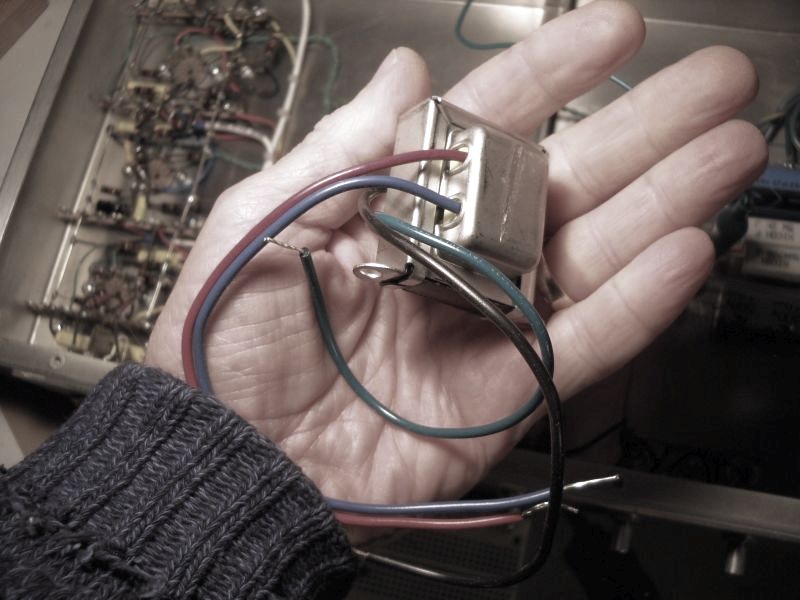
The output transformer is a low cost P-T1750A replacement used in Fender reverb units purchased from amplifiedparts.com. The primary should be wired such that the red wire goes to B+ and the blue wire to the 6SN7 plate. Normally, the output secondary black wire would go to ground and the green wire is the speaker signal. To insure the secondary is wired correctly for negative feedback, connect the R24/C13 feedback loop last. While listening to audio, connecting the feedback loop should cause the audio level to drop slightly. If instead, the level goes up, then the output transformer secondary black and green wires need to be reversed.
Output transformer
The amplifier uses fixed bias on the 6SN7 output stage, allowing bias adjustment for different brands of 6SN7 tubes and to compensate as tubes age. Voltage at the 6SN7 output cathode test point should read between 0.18 VDC and 0.20 VDC. This correlates to 9 mA to 10 mA plate current.
There are two feedback loops. The R24/C13 feedback loop helps reduce distortion in the output transformer. The second feedback loop is plate-to-plate feedback using R23. In total there is only a few db of negative feedback.
6SN7 amplifier circuit
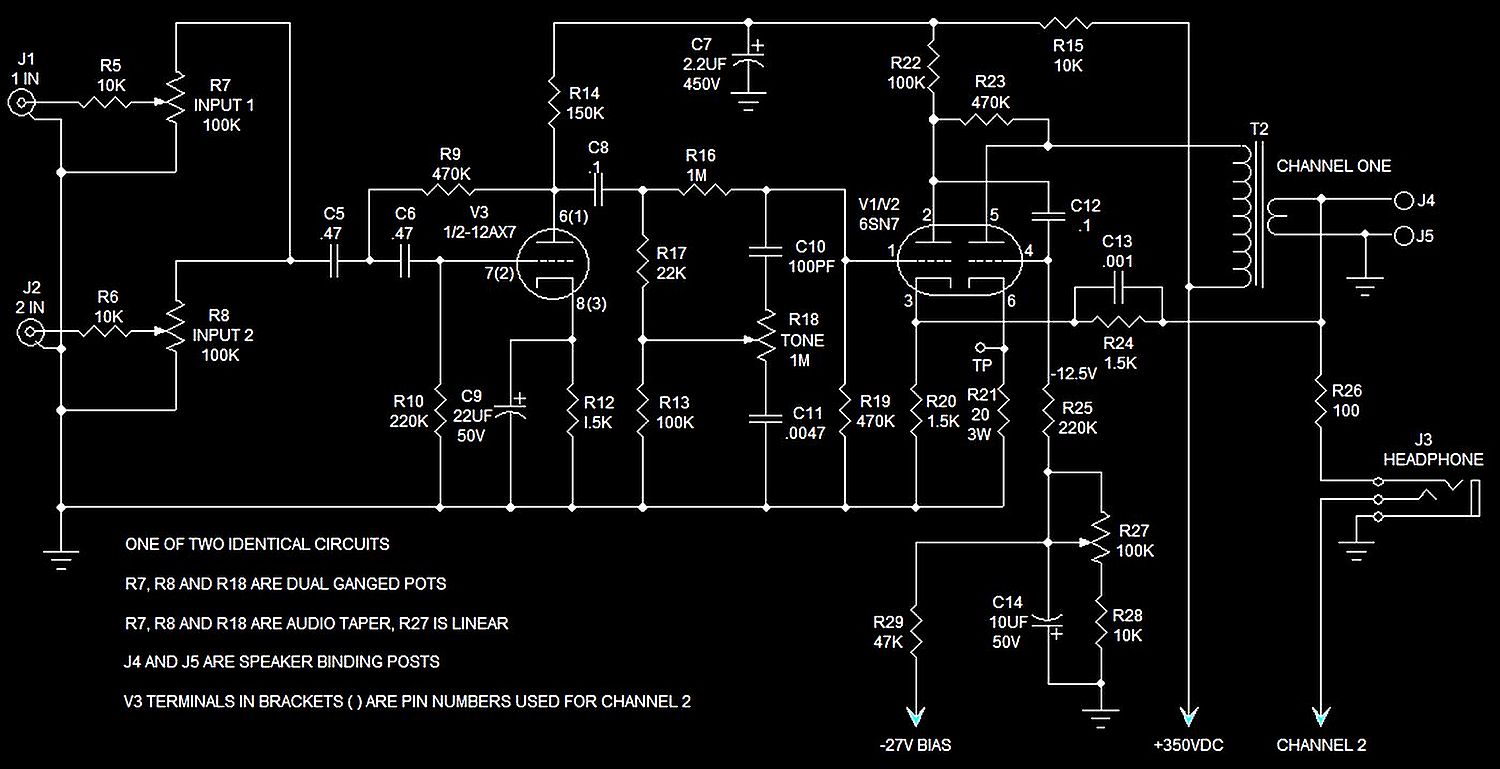
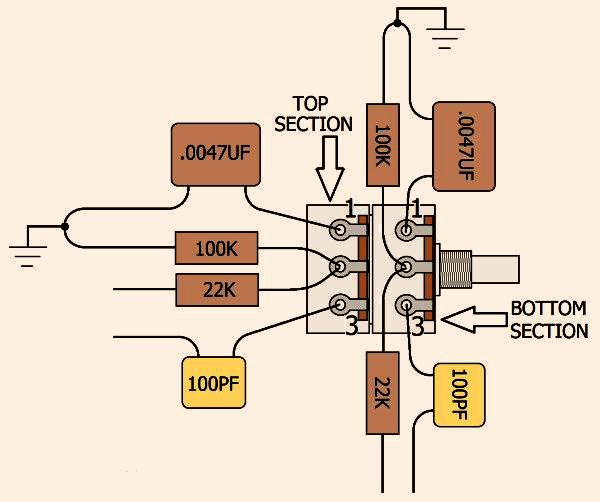
Tone control wiring, full counter-clockwise rotation, is high-end cut (pot wiper at .0047uf capacitor). Full clockwise is high-end boost (pot wiper at 100pF capacitor).
6SN7 amplifier tone control wiring
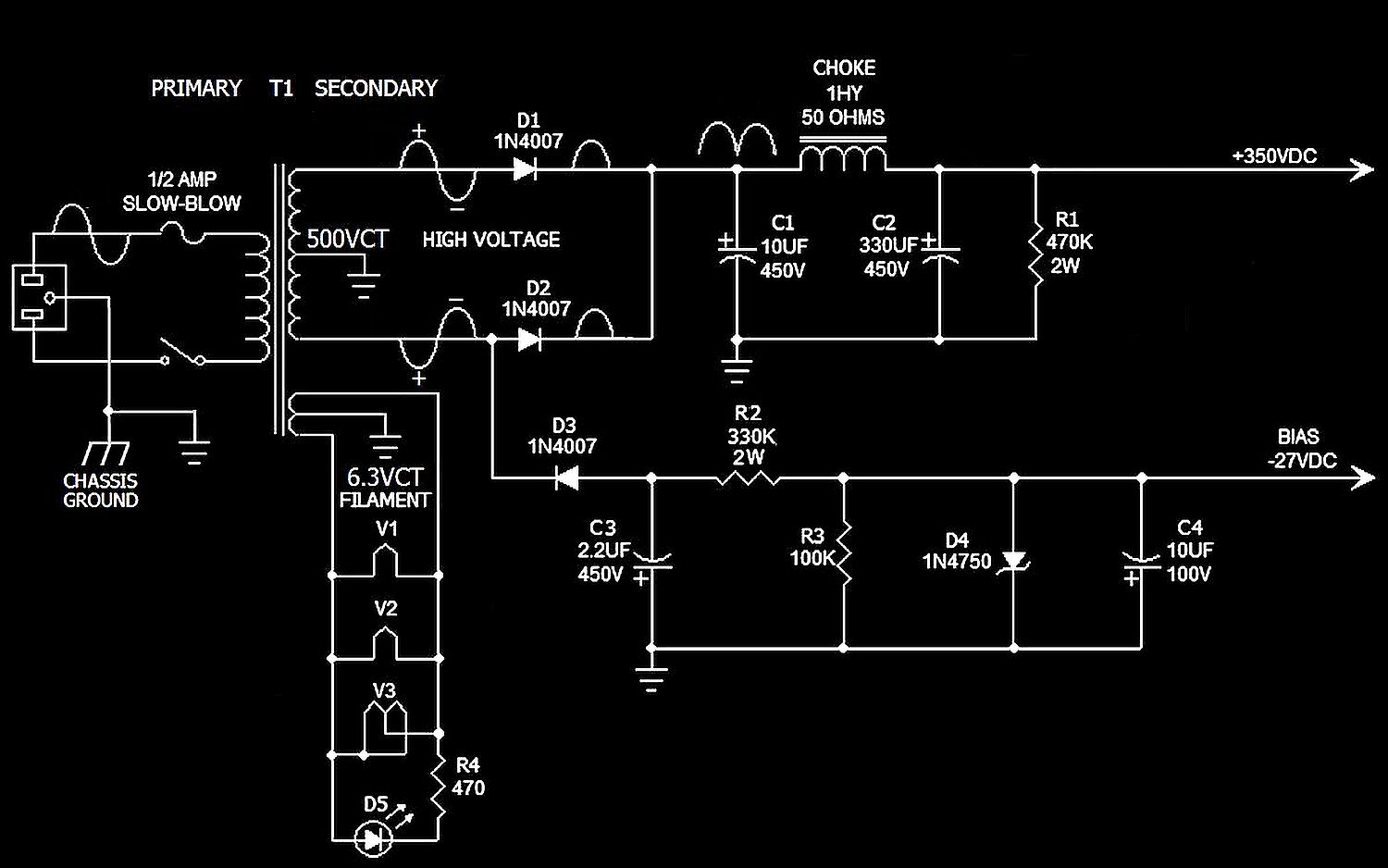
The power transformer used was purchased from Allied Electronics under part number 6K88VG. Allied Electronics
is now RS Industrial Products. Use the following specifications as a guide for an alternate source.
PRI: 110-120V, 50/60Hz,
500VCT @ 40DC mA,
6.3VCT @ 2.0A
6SN7 amplifier power supply circuit
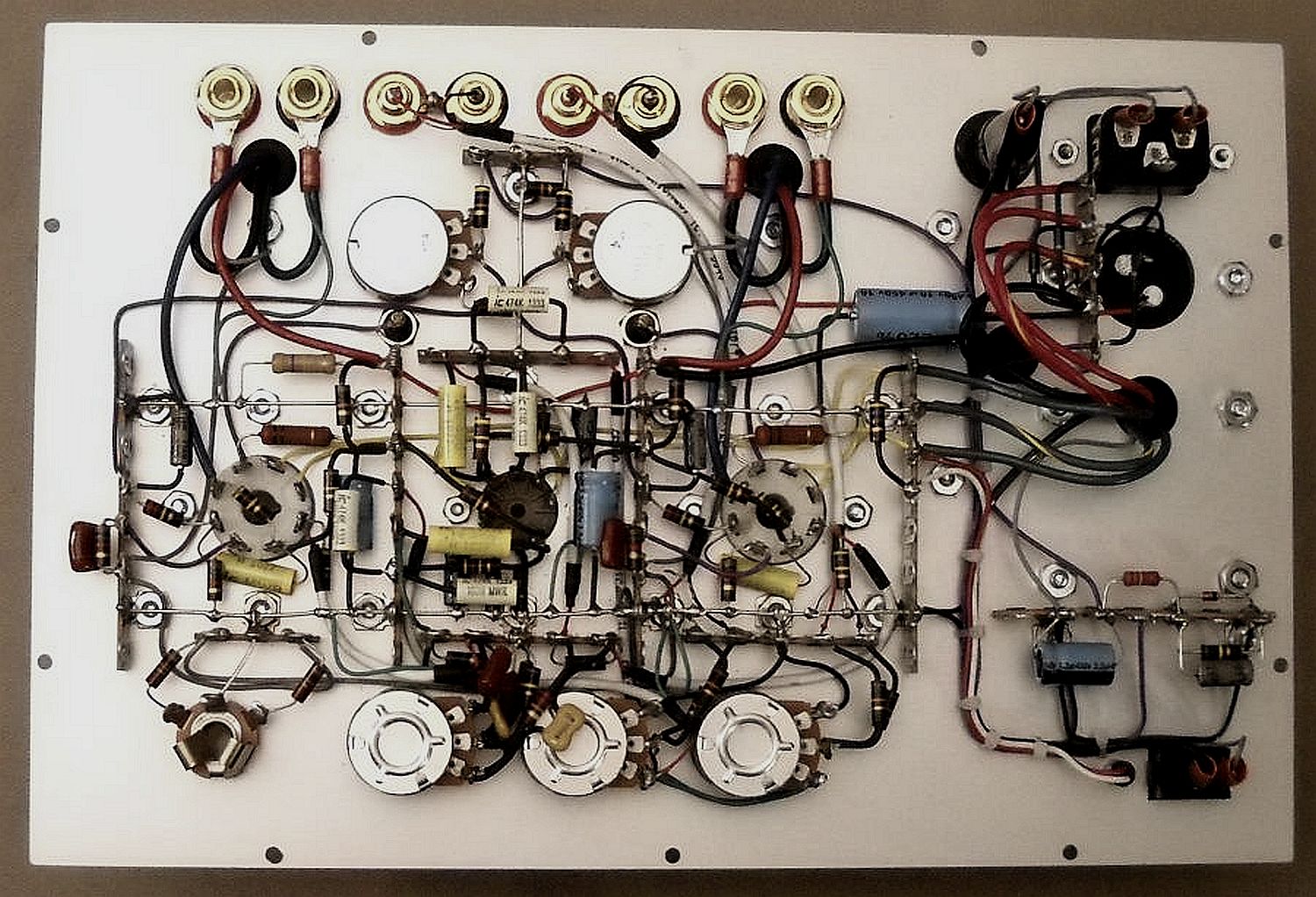
Mounting terminal strip terminals so the grounded lugs line up allowed running buss wire throughout the amplifier. Using buss wire for ground points makes wiring simpler. Some may criticize using terminal strip ground lugs with multiple chassis ground points as bad design. As long as all the ground points are wired together, the multiple chassis ground points are inconsequential. This author has never had noise or hum problems using this method.
6SN7 amplifier wiring finished
Two-watt metal film resistors are physically about the same size as half-watt carbon resistors. If using metal film resistors, two-watt sized metal film resistors are more suitable for point-to-point wiring.
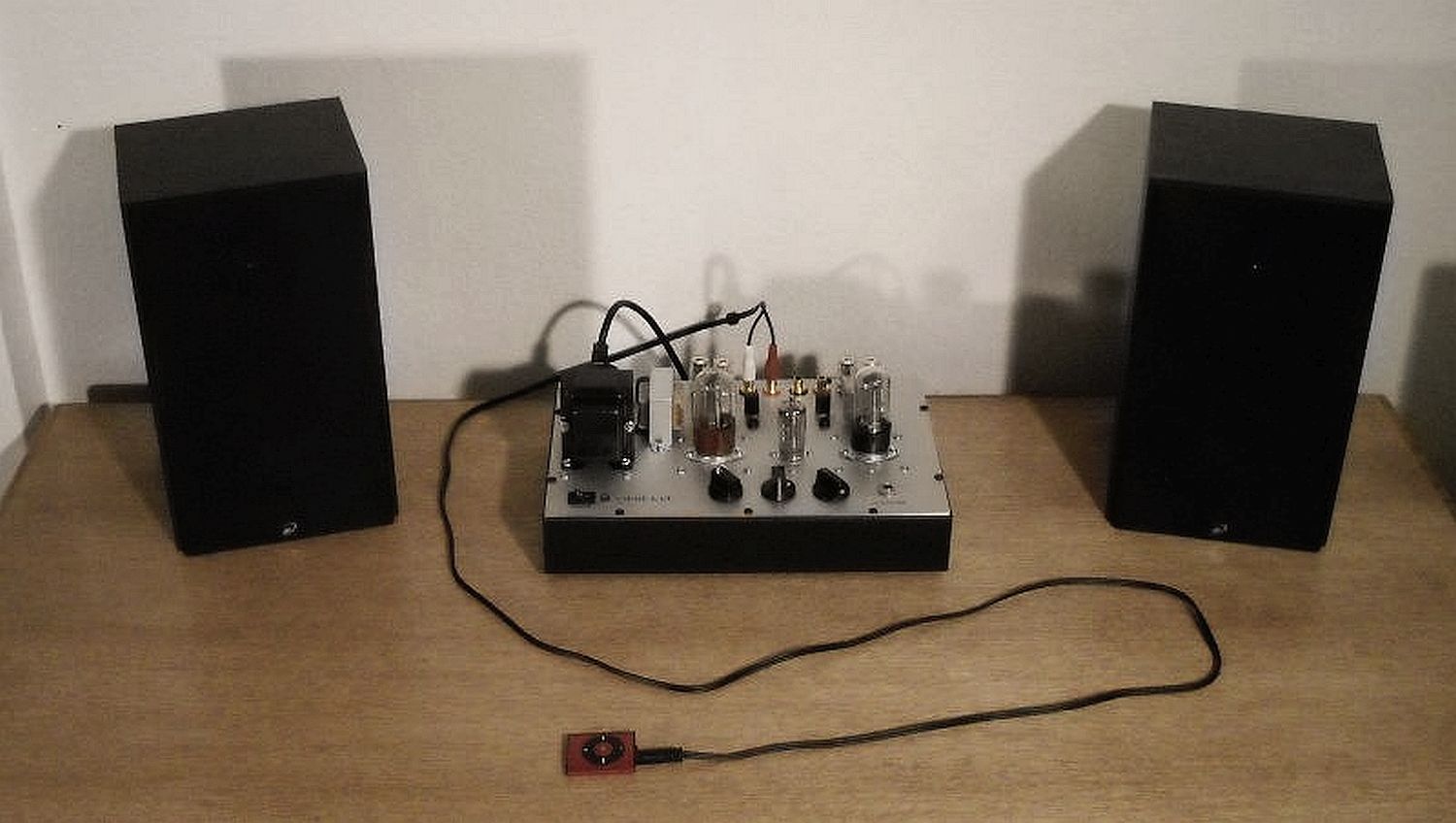
6SN7 amplifier test using MP3 player as source
copyright 2021
A friendly reminder
Home
6SN7 Delux SE Triode Amplifier
Measure Amplifier Damping Factor
Selecting Capacitors For Low Distortion
Lead-free Solder
My Human Distortion Analyzer
Rejuvenation of Vacuum Tubes
by Lane S. Upton
1973 Reprint PDF
Opens in a new tab
Please note that Ed does not build amplifiers on consignment or offer amplifier repair services.
DISCLAIMER
Any circuits or project information presented on ejjurich.com has been tested for safe operation. Vacuum tubes get hot. Amplifiers with exposed vacuum tubes should be operated out of reach of children. Project assembly usually involves fabrication with tools and the use of a hot soldering iron. It is up to the project builder to insure the safety of everyone involved, including curious onlookers. EJ Jurich and ejjurich.com assumes no responsibility for damage, injury or otherwise related to any use of information on this site or given by other means. Many electronic circuits, in particular vacuum tube circuits, operate with dangerous voltage and current. Always exercise care when working with electronic circuits.