DIY Vacuum Tube Amplifiers
Website of EJ Jurich
Class A Audio Reproduction
High Fidelity
Class A Single-Ended Triodes
At home in an average-sized room, using reasonably efficient speakers, 1−watt of amplifier power provides a comfortable volume level while keeping speaker distortion at its lowest level (1). From the perspective of High Fidelity audio reproduction, in the home environment, an audio system does not require a lot of amplifier power to achieve 80 to 85 dB sound pressure levels (SPL). The following few paragraphs cover the reasoning for Class A single-ended triode audio reproduction.
How I Discovered Triodes
During the winter of 2020, I worked on an experiment to see how much power I could squeeze out of 6SN7 tubes
wired as Class A SE output tubes. What I came up with was a pair of 6SN7s in parallel that at 1KHZ put out
almost 5 watts. In 2025, I decided to refine the circuit, including a method to reduce plate current at
lower listening levels. A more practical maximum power output turned out to be 4 watts. Listening to
the experimental single channel (mono) circuit for a few months, I marveled at how good the sound was. Now
I am in the process of creating a finished stereo all 6SN7 amplifier, the 6SN7 Delux (as I call it).
Besides sounding great, 6SN7 tubes are cost competitive compared to commonly available triode power tubes.
Once a working stereo version is finished, the circuit will be available for DIY projects.
EJ Jurich
Single-Ended Triodes Sound Better
Single-ended amplifiers use one tube (or parallel tubes) to handle the entire 360 degrees of the audio waveform. Because there is no signal waveform splitting between alternating tubes, they completely avoid the crossover distortion and switching anomalies that can occur using signal splitters and two tubes in push-pull designs. Push-pull topologies cancel out even-order harmonics (which sound musical) and leave behind harsher odd-order harmonics (3rd, 5th, etc.). Single-ended triode designs let the rich even-order spectrum remain intact.
Why To Not Use Pentodes
A single-ended pentode/tetrode will produce more power output than a single-ended triode. However, triodes offer significantly better plate load matching characteristics than pentodes or tetrodes. Unlike triodes, pentodes inherently generate higher levels of 3rd and odd-order harmonics. These harmonics sound harsher and more fatigued to the human ear. Triodes have a much lower internal plate resistance. This low internal resistance yields vastly superior damping, more predictable load-line behavior, and far greater tolerance to the shifting impedance of real-world speaker loads. Pentodes naturally have a very high internal plate resistance. This results in a low damping factor, meaning the amplifier has poor control over the speaker cone's movement.
Low Frequency Scuttlebutt
Concerns over Class A bass frequency distortion are a bit misleading. With a rare exception, in music recordings there is little or no energy below 50 Hz. This is based on many hours of observing music on lower frequency waveforms. Also, as long as lower frequencies are sinusoidal in nature, bass frequencies can tolerate some distortion before becoming objectionable. What's important is that frequencies above 200 Hz are essentially clean and true to the original input signal.
Speaker Distortion
Speaker distortion is a phenomenon where speaker distortion increases as power to the speaker is increased. With
the advent of AI, you can search for detailed information on what causes speaker distortion and the amount of
distortion at low volume compared to high volume distortion. Besides speaker distortion, also search for dangers
of home audio high volume SPL levels of 90 dB and higher.
Return to top of page
6SN7 Delux SE Triode Amplifier
DIY Half-Watt 6SN7 Amplifier
for Headphone & Speaker
Measure Amplifier Damping Factor
Selecting Capacitors For Low Distortion
Lead-free Solder
Rejuvenation of Vacuum Tubes
by Lane S. Upton
1973 Reprint PDF
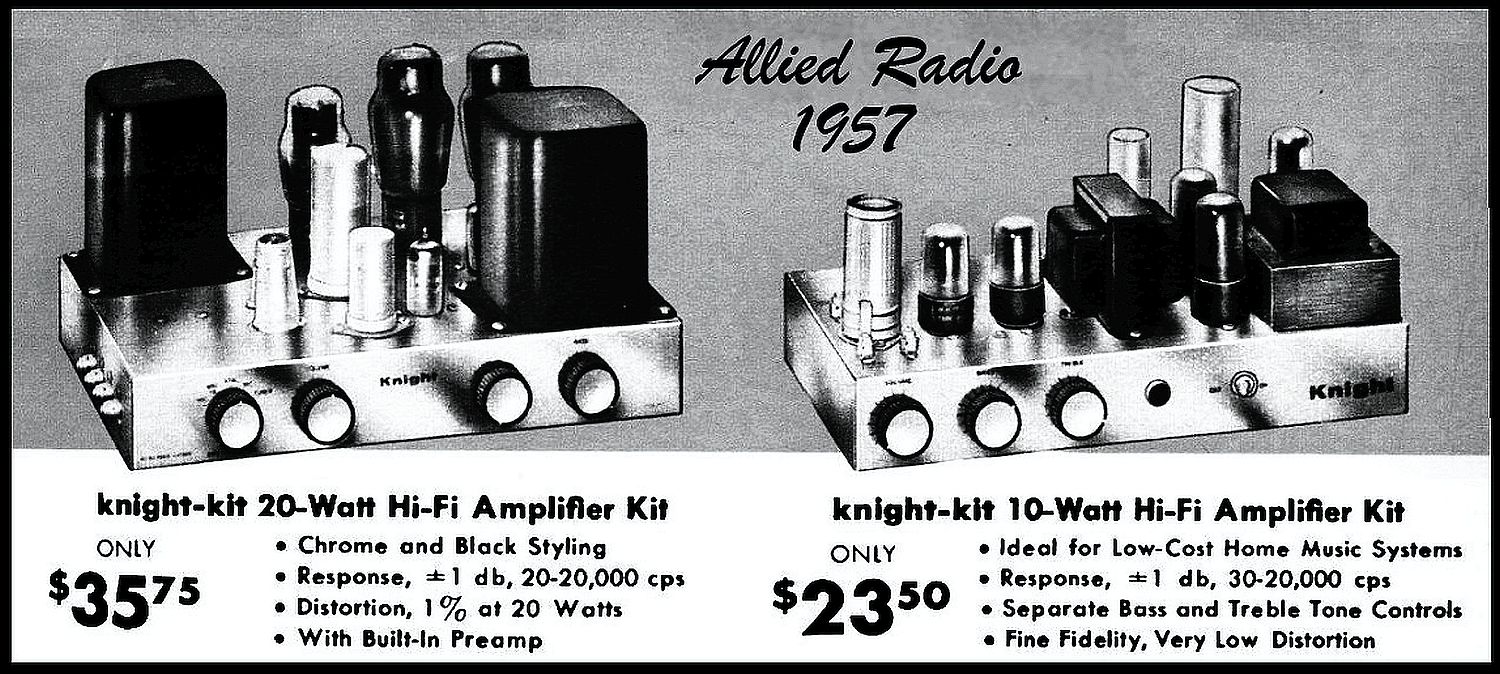
1950s Mono Hi-Fi Amplifier Kits